


If you want to plan your itinerary by yourself, Hyperdia will be a very useful tool.
This site is a comprehensive transportation search engine where you can look up timetables and routes for trains, flights, and airport shuttle buses.
I think it is the most convenient site available for travelers.
However, because it has so many functions and options, you may feel a bit overwhelmed when using it for the first time.
In this post, I will walk you through all the main features of Hyperdia and explain how to use them step-by-step.
By the end, I hope you will feel comfortable using the site and be able to plan your trips smoothly.
How to Use Hyperdia (Video Guide)
If you prefer to learn visually, you can watch the tutorial video below to understand how to use Hyperdia step-by-step.
Basic search
First, go to the Hyperdia.

On the top page, you will see several search fields.
If you just want to look up a simple timetable or route, for example, Tokyo to Shin-Osaka, simply type the station names in the “From” and “To” fields.
Then select your travel date and time.
At the last dropdown menu, you can choose from Departure, Arrival, or Average:
- Departure – Search based on your departure time (most commonly used).
- Arrival – Search based on the time you want to arrive at your destination.
- Average – Shows a range of options between departure and arrival, but this is rarely used.

Example:
If you are flying out of Narita Airport Terminal 2 on December 15 and want to arrive by 15:00, type “Tokyo” in the From field and “Narita Airport Terminal 2” in the To field.
Then select December 15, 15:00, and choose Arrival.
Search with Conditions
When using a JR Pass, you cannot take Nozomi trains on the Tokaido or Sanyo Shinkansen.
Also, most passes issued by the JR Group do not cover private railway lines or subways.
On the other hand, some regional passes for private railways, such as the Kansai Thru Pass, do not cover JR trains.
Hyperdia allows you to filter routes based on these conditions.
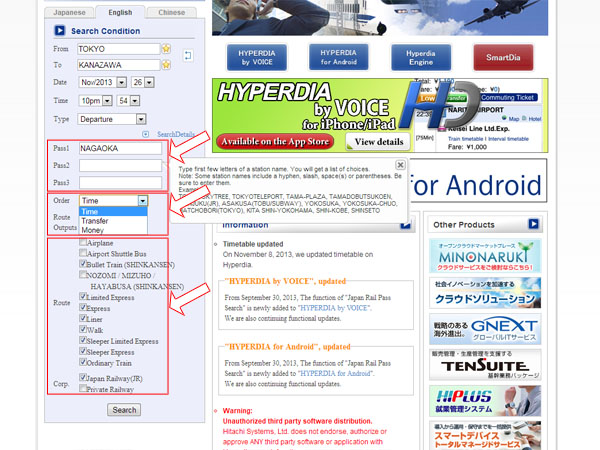
Scroll to the bottom of the search fields and click “Search Details.”
Here, you will see many options to customize your search.
Via 1, Via 2, and Via 3
Sometimes multiple routes are available between two cities.
If you want to force your route to go through a specific station, enter the station name in the Via 1 field.
Example:
If you want to travel from Tokyo to Takayama via Nagoya, input:
- From: Tokyo
- To: Takayama
- Via 1: Nagoya
You can enter up to three intermediate stations using Via 1, Via 2, and Via 3.
Sorting Results
You can choose how the search results are sorted:
- Best Departure Time – Default setting.
- Transfer – Prioritizes routes with the fewest transfers.
- Money – Prioritizes routes with the lowest total cost.
Check Boxes
There are check boxes to include or exclude certain transportation types.
Example:
If you are using a JR Pass to travel from Shin-Osaka to Hakata,
uncheck “NOZOMI / MIZUHO / HAYABUSA (SHINKANSEN)” because Nozomi and Mizuho trains are not covered by the JR Pass.
However, note that Hayabusa is categorized in the same group, but it is covered by the JR Pass.
If you are traveling north to places like Shin-Aomori or Shin-Hakodate-Hokuto, you should keep this option checked.
Private railways are also not covered by the JR Pass, so you may want to uncheck “Private Railway” as well.
Similarly, uncheck “Airplane” and “Airport Shuttle Bus” unless you want flight results included.
Advanced Features

When you get search results, you can access more detailed information by clicking the links provided.
Train Timetable
Shows the departure and arrival times for every station along the train’s route.
This is useful if you are meeting friends along the way and need to know when they can board.

Interval Timetable
This feature shows all trains running on the same segment, allowing you to compare earlier or later trains easily.

Station Timetable
Displays all train departure times for a specific station.
You can click on individual trains for detailed information.

When You Cannot Find a Station Name
Sometimes, Hyperdia may not recognize the station name you enter.
Here are some common reasons and solutions.
Hyphen in Station Names
Some stations require a hyphen (-) in their names.
Stations Starting with “Shin”
For stations beginning with “Shin” (meaning “New”), you often need to include a hyphen.

However, some names do not use a hyphen:
- Shinsapporo (New Sapporo)
- Shinimamiya (New Imamiya)
- Shinsaibashi (no hyphen used)

Stations Starting with Cardinal Directions
Stations that start with Higashi (East), Nishi (West), Minami (South), or Kita (North) often require a hyphen:
- Minami-Chitose (South Chitose)
- Nishi-Akashi (West Akashi)
But sometimes, there is no hyphen:
- Nishiumeda (West Umeda)
Stations with Historical Domain Names
Some stations include historical domain names from the Edo period:
- Aizu-Wakamatsu
- Omi-Maiko
If you cannot find a station, try adding or removing a hyphen.
Anyhow when you cannot find the name, try to put a hyphen.
Same Location, Different Station Names
In large cities like Tokyo or Osaka, multiple stations in the same area may have different names depending on the railway company.
Example: Osaka/Umeda area
- Osaka (JR)
- Kitashinchi (JR Tozai Line)
- Umeda (Hanshin Railway)
- Umeda (Hankyu Railway)
- Umeda (Osaka Metro Midosuji Line)
- Higashi-Umeda (Osaka Metro Tanimachi Line)
- Nishi-Umeda (Osaka Metro Yotsubashi Line)
These stations are within walking distance, even though they have different names.
Other examples:
- Hamamatsucho (JR and Tokyo Monorail) / Daimon (Tokyo Subway)
- Namba (Nankai and Subway) / JR-Namba (JR) / Osaka-Namba (Kintetsu & Hanshin)
Station Names Containing the Company Name
When there are multiple stations in the same area, some companies include their company name in the station name:
- Kintetsu-Nara
- Kintetsu-Nagoya
- Seibu-Shinjuku
- JR-Namba

If you cannot find a station by location alone, use Google Maps to check the exact name.
I hope this guide helps you understand how to use Hyperdia to plan your train journeys in Japan.
With a little practice, you’ll be able to search routes quickly and confidently!

Comments
Hi,
Please ignore/delete my previous post.
After re-reading your excellent blog I tried searching the trip again and …..it worked!
Thank you for the wonderful information you provide here.
Regards
No worries, Allan. 🙂
Cheers,
Takeshi / JPRail.com
I am visiting Otaru Hokkaido in July and from here I plan to get to Toyama by train. Is there a direct train from Otaru to Toyama? How many hours? What is the cost? Can a JR Pass be used? What type of seating (example grand class or suite ) for entire journey?
Hi Choo,
There is no direct train. You have to go to Omiya where is a few station before reaching Tokyo. And then transfer to Hokuriku Shinkansen there. Please see the link below. You will find the way to get Tokyo from Sapporo. You can take local or rapid train to get Sapporo.
https://jprail.com/destinations/hokkaido-area/how-to-get-sapporo.html
https://jprail.com/trains/sort-by-departure-arrival-stations/stations-in-hokkaido/hakodate-shin-hakodate-hokuto/direct-access-to-hokkaido-from-tokyo-hokkaido-shinkansen-bullet-train.html
https://jprail.com/trains/sort-by-departure-arrival-stations/stations-in-kanto/tokyo/ueno/tohoku-shinkansen.html
https://jprail.com/trains/sort-by-departure-arrival-stations/stations-in-kanto/tokyo/ueno/hokuriku-shinkansen-direct-access-to-kanazawa-nagano-and-toyama-from-tokyo.html
All trips are covered by JR pass but Gran class is not covered. You have to pay full surcharge even if you use Green type JR pass. You can find the surcharge at Hyperdia. Please see the post above about using Hyperdia.
Cheers,
Takeshi / JPRail.com
Hi there, I was reading all your post for my incoming trip. I have only one questions. If I buy the Japan Rail Pass, for example, I want to use it into Tokyo – I think Yamanote should be fine – and Narita Express, may I need to show my pass every time I want to ride any JR train? or it has bar code or something?
Thanks
Hi Juan,
Whenever you enter the station, you have to go through man gate to show your pass.
When you are in limited express train, the conductor may check your JR pass.
Cheers,
Takeshi / JPRail.com
Hi, I will be arriving at Nagoya international airport and I would like to take an express train to Takayama.
Can I buy the ticket online? If yes, where can I find the online reservation?
After that, I am planning to take a train from Takayama to Nagano. What pass would be suitable for my trip?
Nagoya – Takayama – Nagano – Nagoya
Thank you!
Hi BK,
Online booking is not available. You have to book it after you arrive in Japan. You can book it at the reservation window. Most of JR stations have the window and you can book in advance. So you can book all tickets at once.
There is no deals to cover your trip. Single fare is the best option.
https://jprail.com/travel-informations/other-rail-passes/for-non-jr-pass-travellers-guide-to-use-jr-single-ticket-basic-rules-validity-and-stopover.html
Cheers,
Takeshi / JPRail.com
Hi Takeshi, it’s me again. I am working with hydedia rates and as your example shows it has base fare and reserved/unreserved/express seat fee – so does this mean that for my trip say, from Kamata – Nagoya I will have to pay 200 +6260 + unreserved seat fee (cheapest) 4100 = Y10560 and not just base fare alone? This is if i use single ticket. And if I have rail pass does this mean that the pass will only cover base fares and if I choose reserved seat because it is peak season like in Dec or Jan I will have to pay extra? And is a reserved seat a guaranteed seat or should I go up to Green seat? My apologies for the many questions. Thanks heaps, kc
Hi KC,
If you purchase single ticket, you need to pay both. If you use JR Pass, it covers both single fare and reserved seat charge. You can secure your seat by JR Pass. If you just want to secure your seat, you don’t need to buy Green pass. It’s a sort of business class seat.
Cheers,
Takeshi / JPRail.com
Great! Thank you very much Takeshi! 🙂 Cheers, kc
No worries, KC.
Cheers,
Takeshi / JPRail.com
HOW CAN I GET FROM SAPPORO CTS AIRPORT TO HAKODATE BY TRAIN TQ
Hi Cheah,
You can take local train or rapid train to Minami Chitose. That is one station away from the airport station. And then transfer to limited express Hokuto.
https://jprail.com/destinations/hokkaido-area/hokuto-super-hokuto.html
You also can find some info at one of my trip report.
https://jprail.com/destinations/hokkaido-area/my-trip-from-sapporo-to-otaru-and-hakodate-on-march-20-2012-by-rapid-airport-and-limited-express-hokuto.html
Cheers,
Takeshi / JPRail.com
Hi Takeshi-San,
Can you advise what is the cheaper and faster way to go to Kagoshima from Hakata.
Thanks & Best Regards
May Yong
Hi May san,
Shinkansen is the fastest but bus is cheaper. But I couldn’t fine bus info in English and I’m not familiar with bus either. You may find some more info at the link below:
http://www.japan-guide.com/e/e4604.html
Cheers,
Takeshi / JPRail.com
Hi Takeshi-san,
About the trains and their departure tracks, does it mean if I missed one train I can just go to another track and ride another train that is coming?
Sometimes in my search results there are trains that need transfer (Tra.), does it mean I need to get off a train and get on another train?
If I’m not mistaken in reading the results, the difference of timing on one route to another can be very big, especially with those needing transfer. If indeed I missed one route, should I just take the ones with longer route/time, rather than just wait for another faster route?
Hope you understand what I’m saying.
Here’s one instance: http://bit.ly/1QPsIk7 from Kyoto to Okayama.
Please advise.
Thanks,
Dwi.
Hi Dwi san,
I checked the link that you gave me. There are some trains that go directly to Okayama from Kyoto. And you need to transfer at Shin-Osaka in some cases.
As long as you use JR pass, you can take any Hikari or Kodama or Sakura’s non reserved seat. So if you miss it, you can take next train’s non reserved seat. Even if you have reserved seat and miss it, you can get another reserved seat ticket for next train if you have a time to go to reservation window.
Regarding Shinkansen timetable, the following links show you PDF timetable. I think this is easier to build your plan.
http://english.jr-central.co.jp/info/timetable/_pdf/westbound.pdf
http://english.jr-central.co.jp/info/timetable/_pdf/eastbound.pdf
Cheers,
Takeshi / JP Rail
hai. thanks a lot for sharing this website. 🙂
No problem, Saadiah.
Cheers,
Takeshi / JP Rail
Hello- It’s our first visit to Japan.
We have JR pass voucher.
We are staying at Kansai Washington Hotel.
Kindly let me know which station to go to catch a train to Kyoto.
We are staying at Kyoto Tower Hotel Annex.
Than you very much for your help.
Hi Cyn,
Is your hotel located in Kansai airport? If so, just take limited express Haruka. It takes you to Kyoto station directly.
https://jprail.com/travel-informations/tips-for-japan-rail-pass/how-to-access-from-kansai-airport-to-downtown-osaka-kyoto-and-kobe.html
Cheers,
Takeshi / JP Rail